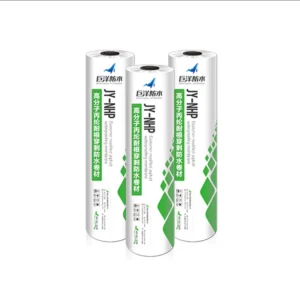

JY-ZXW Fiber Reinforced Polymer Film Based Self-Adhesive Waterproofing Membrane
JY-ZXW Fiber Reinforced Polymer Film Based Self-Adhesive Waterproofing Membrane is produced in our China factory. This manufacturer item features a polymer film base coated with a polymer modified asphalt bonding layer on both sides. The upper surface includes a fiber reinforcement layer, and the lower surface has a peelable silicon coated isolation film. Inquire for current price options.
Product Introduction
The JY-ZXW is a self-adhesive waterproofing membrane produced by Great Ocean Waterproof, designed for use in construction projects requiring moisture protection. It consists of a polymer film base reinforced with fiber, coated on both sides with a polymer-modified asphalt bonding layer. The upper surface features a tear-resistant fiber reinforced layer, while the lower surface includes a peelable silicon-coated isolation film for handling and application.
Available specifications include thicknesses of 1.5 mm or 2.0 mm, with a standard roll length of 20 meters and width of 1.0 meter. This configuration supports applications in areas like underground structures, tunnels, roofs, and basements, where it bonds to surfaces such as concrete.
Similar products in the market, such as those from manufacturers like Joaboa Tech and Younson Technology, often incorporate bituminous materials with fiberglass or polymer reinforcement for added strength. The JY-ZXW aligns with these by providing adhesion without additional primers in many cases, though site conditions should be assessed for compatibility.
For installation, the membrane is applied by removing the isolation film and pressing it onto prepared substrates. It is commonly used in pre-paving scenarios for integration with post-cast concrete, as noted in industry resources on self-adhesive membranes. Always refer to local building codes and manufacturer guidelines for proper use.
| Thickness(mm) | 1.5 / 2.0 | Length(m) | 20 | Width(m) | 1.0 |
| Surface | Tear resistant fiber reinforced layer | Underface | Separator | ||
Performance Characteristics
- Double Reinforcement Structure: The membrane features reinforcement in both inner and surface layers, providing high tensile strength, tear resistance, wrinkle resistance, and slip resistance. It maintains dimensional stability, offers UV resistance, and handles high and low temperatures effectively. The surface includes fiber reinforcement for added tear and slip resistance.
- Self-Healing Capability: Designed to prevent water leakage by compensating for limitations in rigid concrete waterproofing, resulting in a combined rigid and flexible waterproofing system.
- Wet Laying and Self-Adhesive Application: Supports installation on wet surfaces with self-adhesive properties for straightforward construction.
- Double Overlapping Edge Design: Overlapping edges are self-sealing and resist curling. The combination of physical mortise-and-tenon joints and chemical reactions allows the membrane to integrate with building structures, resisting external environmental factors and forming a durable bond.
Performance Index
| No. | Item | Indicator | |
|---|---|---|---|
| 1 | Soluble content/(g/m²) | H - | |
| Tensile property | Tearing force /(N/50 mm) | ≥ 300 | |
| 2 | Elongation at maximum tensile | ≥ 50 | |
| Phenomenon during stretching | The adhesive layer is not separated from the polymer film or tire base | ||
| 3 | Tearing force/N | ≥ 20 | |
| 4 | Heat resistance (70℃, 2h) | No flow, dripping, slip ≤ 2mm | |
| 5 | Low temperature flexibility(-20℃) | No cracks | |
| 6 | Impermeability | waterproof | |
| 7 | Roll and roll peel strength/(N/mm) | No processing | 1.0 |
| Immersion treatment | 0.8 | ||
| Heat treatment | 0.8 | ||
| 8 | Oil leakage/number of sheets | ≤ 2 | |
| 9 | Holding viscosity/min | ≥ 30 | |
| 10 | Peel strength with cement mortar/(N/mm) | No processing | ≥ 1.5 |
| Heat treatment | ≥ 1.0 | ||
| 11 | Peel strength after immersion in cement mortar (N/mm) | ≥ 1.5 | |
| 12 | Thermal ageing (70℃, 168h) | Tensile retention rate/% | 90 |
| Elongation retention rate/% | 80 | ||
| Low temperature flexibility (-18℃) | No cracks | ||
| 13 | Dimensional change/% | ±1.0 | |
| 14 | Thermal stability | No bulging, smooth, with maximum curling of polymer film or tire base edge not exceeding 1/4 of the side length | |

Product Applications
The JY-ZXW membrane is designed for waterproofing in non-exposed areas, particularly in underground and indoor engineering for a range of building types. This includes applications in open-cut subways, tunnels, water tanks, and water channels, where it provides moisture barrier protection against groundwater seepage or humidity in enclosed environments. In these settings, the membrane's self-adhesive nature allows for installation without mechanical fasteners, reducing potential weak points in the waterproofing layer.
It is well-suited for projects where open flames are not permitted, such as in confined spaces or areas with flammable materials nearby. For underground waterproofing, its tear-resistant fiber reinforcement helps maintain integrity during backfilling or soil settlement, minimizing risks of punctures from sharp aggregates or debris. On sloping roofs, the slip-resistant surface aids in secure placement, especially on inclined concrete or metal substrates, preventing shifts during application or under subsequent loads.
Additionally, the membrane integrates effectively with surface-applied waterproof coatings, allowing for layered systems in combined constructions. This is common in basements, parking garages, or utility vaults, where the JY-ZXW serves as a base layer bonded to the substrate, and coatings provide an extra seal on top. In such hybrid setups, the membrane's compatibility with wet laying ensures adhesion even on damp surfaces, which is practical in regions with high humidity or during rainy seasons.
Overall, this product aligns with standard practices in civil engineering waterproofing, similar to other polymer-modified asphalt membranes used in infrastructure projects. Users should evaluate site-specific conditions, such as substrate preparation and environmental exposure, to ensure optimal performance, and consult relevant standards like those from ASTM or local building regulations for guidance.
Comparison of Similar Self-Adhesive Waterproofing Membranes
Self-adhesive waterproofing membranes are commonly used in construction for below-grade, roofing, and indoor applications where moisture protection is needed without open flames. The JY-ZXW Fiber Reinforced Polymer Film Based Self-Adhesive Waterproofing Membrane from Great Ocean Waterproof is one such product, featuring a polymer film base with fiber reinforcement and polymer-modified asphalt bonding. Below is a comparison with similar products available in the market, based on publicly available specifications from manufacturers like Grace, Polyguard, and MFM. This focuses on key attributes such as composition, dimensions, reinforcement, applications, and general pros/cons. Note that actual performance can vary by site conditions, and users should consult manufacturer data sheets for precise details.
| Product | Composition | Thickness Options | Reinforcement | Standard Dimensions | Key Applications | Advantages | Disadvantages |
|---|---|---|---|---|---|---|---|
| JY-ZXW (Great Ocean Waterproof) | Polymer film base coated with polymer-modified asphalt on both sides; upper fiber-reinforced layer; lower peelable silicon-coated isolation film. | 1.5 mm or 2.0 mm | Tear-resistant fiber in upper surface; double inner/surface reinforcement for tensile strength. | Length: 20 m; Width: 1.0 m | Non-exposed underground (e.g., subways, tunnels, basements, water tanks); sloping roofs; combined with coatings; wet laying compatible. | Self-healing for leaks; slip/wrinkle/UV resistant; self-sealing overlaps; integrates with concrete for rigid-flexible system; no flames needed. | May require substrate prep; limited to non-exposed areas; potential curling if not applied properly. |
| Bituthene 4000 (Grace Construction Products) | High-density polyethylene (HDPE) carrier film with rubberized asphalt compound; pre-formed sheet. | Typically 1.5 mm (60 mil) | Cross-laminated HDPE for strength and puncture resistance. | Length: 20 m; Width: 1.0 m (rolls) | Below-grade foundations, tunnels, plazas; vertical/horizontal surfaces; compatible with concrete pours. | Consistent thickness; cold-applied; bonds well to damp surfaces; durable against hydrostatic pressure. | Adhesion reduced in very cold weather; seams need careful sealing; higher cost for complex detailing. |
| Polyguard 650 Membrane (Polyguard Products) | Rubberized asphalt compound with high-density polyethylene film; post-concrete pour sheet. | 1.5 mm (60 mil) | HDPE film for flexibility and tear resistance. | Length: 18.3 m; Width: 0.91 m | Exterior vertical walls, slabs, ICFs, CMUs; vapor retarder in foundations and tunnels. | Flexible for irregularities; no primers often needed; effective vapor barrier; easy peel-and-stick. | Not ideal for exposed surfaces; may need protection boards; limited cold-weather tackiness. |
| MFM SubSeal (MFM Building Products) | Rubberized asphalt with polyethylene film; available in 40 or 60 mil variants. | 1.0 mm (40 mil) or 1.5 mm (60 mil) | Polyethylene reinforcement for tensile and tear strength. | Length: 20 m; Width: 0.91 m or 1.0 m | Foundations, balconies, below-grade walls; drainage and waterproofing combos. | Self-adhering without heat; compatible with dimple boards; good for multi-layer systems. | Potential for edge curling; requires clean, dry substrates; less flexible on highly irregular shapes compared to fluids. |
This comparison draws from industry sources, including manufacturer descriptions and general waterproofing guides. For instance, self-adhesive membranes like these are often preferred over torch-applied (e.g., SBS modified bitumen) for safety in confined spaces, but they may underperform in extreme cold compared to fluid-applied options (e.g., CIM or polyurethane coatings), which offer seamless coverage but vary in thickness. Fluid-applied alternatives can reduce labor by up to 60% on complex substrates but lack the uniform factory-controlled thickness of sheets. Always verify compatibility with local codes and test for specific project needs.
Installation Guidelines
The JY-ZXW membrane supports multiple installation methods depending on project requirements, such as pre-laying for underground structures, wet laying for bonding with cement-based layers, and self-adhesive for general applications. Below are detailed procedures drawn from standard construction practices for this type of fiber-reinforced, polymer-modified asphalt membrane. Always follow site-specific engineering plans, safety protocols, and local regulations during application.
Pre-Laying Construction Technology
This method is commonly used in underground engineering where the membrane is installed before concrete pouring to form an integrated waterproof layer.
- Surface Preparation: Start with flat horizontal surfaces, then move to vertical ones. Build temporary protective walls using lime mortar and coat the inner surface with an isolation agent to prevent adhesion during removal.
- Overlapping and Pressing Rolls: Overlap the edges of pre-laid waterproof rolls and use a pressure roller to secure them, ensuring complete bonding. At low temperatures, a hot air welding gun can assist in heating for better adhesion.
- Sealing Overlaps: Rolls are overlapped using the self-adhesive method, with staggering in the overlapping areas at the ends.
- Mechanical Fixation During Facade Work: Secure the membrane every 400mm-600mm, maintaining a 10mm-20mm distance from the self-adhesive edge to avoid gaps. This ensures the fixed structure covers the roll material fully. Avoid damaging the waterproof layer during concrete pouring.
- Contact Area Handling: Fold the roll material from the bottom to the facade. Use the empty laying method for contact between the roll and temporary protective walls or enclosure templates; temporarily adhere or fix the material to the wall or template at the top.
- Joints Without Protective Walls: At joints, fold the material from the bottom to the facade and implement reliable protective measures.
- Post-Concrete Completion: Once the concrete structure is set and facade rolls are laid, remove joint layers first, clean surfaces, and repair any damage promptly. The overlap length at roll material joints is 150mm.
Wet Laying Method Construction
Suitable for bonding the membrane to base layers using cement slurry or mortar, often in grassroots treatments.
- Grassroots Treatment: Ensure the base is solid, flat, dry, clean, and free of sanding, dust, or oil stains. The roll material bonds to the base using cement slurry or mortar. For slurry, add 3%-5% rubber powder by cement weight; for mortar, use a cement:medium sand ratio of 1:2. Adjust water amounts on-site based on base moisture, recommending ordinary Portland cement (grade 42.5). Mix evenly and scrape onto the base layer.
- Large-Scale Construction: Lift the roll to the designated spot for laying. Pre-lay first, release stress fully, align with reference lines, lift the isolation film from the bottom, fix one end, then use a pressure roller to roll and exhaust air while pushing and laying.
- Maintenance: After laying the roll material, maintain it for 48 hours (duration varies by ambient temperature; higher temperatures shorten the time required). This allows the adhesive to set properly under typical site conditions.
Self-Adhesive Construction Method
This flame-free method is ideal for grassroots that meet flatness and cleanliness standards.
- Grassroots Treatment: Base should be solid, flat, dry, clean, and free of sand, dust, or oil stains. Fill unevenness or cracks with mortar. Inspect and accept the base before construction, then clean and sweep it. Use a vacuum cleaner or high-pressure dust blower if needed to remove debris.
- Applying Base Treatment Agent: Before laying, apply the agent evenly and completely over all parts of the roll material base, avoiding omissions or accumulation.
- Detail Node Treatment: After the agent dries, treat areas needing additional waterproof layers promptly per specifications or design. For hard-to-stick details, use a spray gun or heating equipment for auxiliary heating during construction. Additional layers for general areas should fully adhere to the base; stress-concentrated areas should be laid empty per specifications.
- Large-Scale Construction - Horizontal Surface: Snap lines after the agent dries, pre-lay by unwinding, fully release stress, then lay the roll. Fix the starting end first, spread it out gradually, release isolation material, and lay from low to high.
- Vertical Facade: Construct the roll and base, as well as roll-to-roll, using full bonding. Fix the facade roll end with metal pressure strips first, then seal with roll sealant.
- Protective Isolation Layer Construction: After laying and inspecting the roll as qualified, clean the waterproof layer surface. Take protective measures for the waterproof layer per design. Carry out waterproof protection layer construction accordingly. Set an isolation layer between the waterproof layer of the roll material and rigid protection; use low-quality asphalt roll material, plastic film, paper reinforcement ash, etc., as isolation material.

Related Cases
For broader context, here are documented applications of similar self-adhesive, fiber-reinforced polymer membranes from other manufacturers. These demonstrate real-world performance in scenarios suitable for JY-ZXW, such as blindside shoring, under-slab protection, and combined coating systems.
- Century City Center and Echelon Sites (Los Angeles, USA) EPRO's E.Protect+ and PreTak HDPE self-adhesive membranes were installed over 255,000 square feet for below-grade walls and slabs in high-rise developments. Pre-laying on soil retention systems bonded with cast-in-place concrete, resisting hydrostatic pressure and contaminants. Outcome: No lateral water migration after completion, with fast installation using 8-foot-wide rolls minimizing seams. This aligns with JY-ZXW's tear-resistant fiber layer for puncture protection during backfilling.
- 1 Bank Street, Canary Wharf (London, UK) SikaProof P-12 FPO self-adhesive membrane was post-applied to existing reinforced concrete basements in a financial district tower. It provided damp-proofing against groundwater, with flexible overlaps ensuring a watertight seal. Outcome: Successful integration in a retrofit scenario, preventing ingress in a flood-prone urban area, similar to JY-ZXW's double overlapping edge design for environmental resistance.
- Papworth Hospital (Cambridge, UK) Using SikaProof membranes for below-ground waterproofing in a healthcare facility expansion. The system combined with coatings for layered protection on tunnels and water tanks. Wet laying on damp surfaces compensated for rigid concrete limitations. Outcome: Achieved zero leaks post-construction, with enhanced durability in variable temperatures, echoing JY-ZXW's self-healing and UV-resistant properties.
- Ocean City Boardwalk (New Jersey, USA) An encapsulation project under the boardwalk used self-adhered membranes to waterproof a central courtyard and pedestrian areas. The system addressed moisture from ocean proximity, with slip-resistant surfaces for sloping elements. Outcome: Transformed a leaky space into a clean, functional area, reducing corrosion and maintenance. This case underscores the benefits of flame-free application in confined, flammable-risk zones, applicable to JY-ZXW.
- Kiley Gardens Restoration (Tampa, Florida, USA) A historic site used polymer-modified bitumen self-adhered membranes for roof and foundation waterproofing. Challenges included root penetration at seams, resolved with reinforced overlaps and protective layers. Outcome: Eliminated water intrusion to the structure below, with lessons on seam detailing for long-term performance—relevant for JY-ZXW's mortise-and-tenon chemical bonding.
In summary, these cases show self-adhesive membranes like JY-ZXW excelling in underground and non-exposed applications, offering quick installation, strong bonds, and resistance to environmental stresses. For optimal results, site assessments for substrate conditions and adherence to guidelines (e.g., ASTM standards) are recommended. If specific JY-ZXW projects become publicly detailed, they would likely follow similar patterns in infrastructure like subways or basements. For tailored advice, contacting Great Ocean Waterproof directly is suggested.
Customer Reviews
John R., United States Rating: 4/5
We used this membrane for a basement retrofit in a residential project in the Midwest. The self-adhesive feature worked as described on damp concrete surfaces, and the fiber reinforcement held up during backfilling without tearing. Overlaps sealed without issues, but we had to be careful with low temperatures to ensure proper bonding. It's been holding against groundwater seepage for about a year now, no leaks so far.
Li Wei, China Rating: 4/5
Applied this in a tunnel waterproofing job in Shanghai. The double reinforcement provided decent tensile strength, and it integrated well with the concrete pour using the pre-laying method. The peelable isolation film made handling straightforward on site. We've noticed good dimensional stability in humid conditions, though edge curling required extra pressing in some spots. Overall, it met the project specs without major problems.
Emma T., United Kingdom Rating: 3.5/5
Installed on a sloping roof for a commercial building in London. The slip-resistant surface helped during application on an incline, and it bonded reliably without primers. Combined it with a surface coating as recommended, and it's managed typical rain exposure fine. However, the 20m roll length meant more joints than we'd prefer for larger areas. No complaints on UV resistance for the non-exposed parts.
Marcus S., Germany Rating: 4/5
Used for underground water tanks in a Munich engineering project. The self-healing aspect compensated for minor concrete cracks, creating a functional rigid-flexible system. Wet laying was practical in our variable weather, and the material didn't wrinkle much. Tear resistance was adequate against debris, but we reinforced high-stress areas. It's performed consistently over six months, aligning with our expectations for durability.
Sarah K., Australia Rating: 4/5
Applied in a subway expansion near Sydney, focusing on non-exposed underground sections. The flame-free installation was a plus in confined spaces, and the overlapping edges sealed effectively without curling. It handled soil settlement without visible damage, and the 1.5mm thickness provided sufficient protection. We've monitored for a few months, and it's kept moisture out as needed, though prep work on the substrate was key to adhesion.

About Our Factory
Great Ocean Waterproof Technology Co., Ltd., formerly known as Weifang Great Ocean New Waterproof Materials Co., Ltd., is situated in Taitou Town, Shouguang City, which serves as the largest waterproof materials base in China. Established in 1999, the company operates as a high-tech waterproof manufacturer that combines research, production, and sales.
The factory occupies an area of 26,000 square meters and has expanded over the years to include multiple production lines for coils, sheets, and coatings, aligned with advanced standards in the domestic industry. Key products encompass polyethylene polypropylene (polyester) polymer waterproof membranes, polyvinyl chloride (PVC) waterproof membranes, thermoplastic polyolefin (TPO) waterproof membranes, high-speed rail-specific chlorinated polyethylene (CPE) waterproof membranes, polymer polypropylene self-adhesive waterproof membranes, non-asphalt-based reactive pre-laid polymer self-adhesive film waterproof membranes, strong cross-laminated film polymer reactive adhesive waterproof membranes, protective drainage boards, elastomer/plastomer modified asphalt waterproof membranes, asphalt-based self-adhesive waterproof membranes, polymer modified asphalt root-puncture resistant waterproof membranes, metal-based polymer root-puncture resistant waterproof membranes, root-puncture resistant polymer polyethylene propylene (polyester) waterproof membranes, root-puncture resistant polyvinyl chloride PVC waterproof membranes, single-component polyurethane waterproof coatings, two-component polyurethane waterproof coatings, polymer cement (JS) composite waterproof coatings, water-based (951) polyurethane waterproof coatings, polyethylene propylene (polyester) special dry powder adhesive, cement-based permeable crystalline waterproof coatings, spray quick-setting rubber asphalt waterproof coatings, non-curing rubber asphalt waterproof coatings, exterior wall transparent waterproof glue, high-elasticity liquid membrane waterproof coatings, self-adhesive asphalt waterproof tapes, butyl rubber self-adhesive tapes, and several dozen other varieties.
The company maintains a robust technical team with professional personnel, equipped with advanced machinery and comprehensive testing instruments to ensure consistent and reliable product quality, as verified by national authoritative inspection bodies. It has received the "Comprehensive Quality Management Standard" designation from the National Ministry of Agriculture, along with quality assurance system certification. Additionally, it holds recognition as a "National Authoritative Testing Qualified Product" unit from the China Quality Inspection Association, as well as the Shandong Province "Industrial Construction Product Filing Certificate" and "Industrial Product Production License."
Great Ocean Waterproof adheres to principles of contract compliance and credibility. Its products are distributed across more than 20 provinces and regions in China and exported to various countries abroad, receiving positive feedback from users.
The company employs a modern operational and management framework, guided by the corporate spirit of "integrity, pragmatism, innovation" and the purpose of "win-win sharing." It focuses on delivering products with competitive pricing and reliable service to collaborate with clients in market expansion and ongoing development.


![JY-ZSH High Strength Self-Adhesive Waterproofing Membrane [H]](https://great-ocean-waterproof.com/wp-content/uploads/2025/12/JY-ZSH-High-Strength-Self-Adhesive-Waterproofing-Membrane-H2_1-300x300.webp)